
Rodent service
Los Angeles Attic Cleaning
Getting the rats out of an attic is half the job. What they leave behind stays up there until somebody takes it out.
What a rodent attic actually holds
About half the rat jobs we solve in this basin are roof rats, and those live overhead. By the time the scratching stops, the attic has usually had months of them: droppings along the joists and on top of the ducting, nesting material packed into the corners and under the eaves, and insulation that has been tunnelled through, flattened and soaked with urine.
None of that leaves with the last rat. The smell stays, and so does the contamination. The CDC warns against sweeping or vacuuming rodent droppings and urine until they have been disinfected, because dry sweeping lifts them into the air. In an attic, that air is a few feet above your bedrooms.
Attics in Los Angeles
There is no winter here to thin the rats out, so an attic that has had them since spring has usually had them all year. On a tile roof, the open ends of the first course are a way in, straight under the tiles and onto the attic floor.
What they leave matters more in this county than most. Los Angeles County Public Health recorded 220 cases of flea-borne typhus in 2025, the most it has ever counted, and says the infected fleas here are commonly found on rats, stray cats and opossums. Old nests left in the insulation are not something to live under.
How we clean it
Order matters, so the cleaning comes last. We find how they are getting in and seal those entry points first with our lifetime-warranted rodent-proofing products. Then we trap and monitor, typically for up to 15 days, and come back for the cleanup once the activity has stopped. In the twins’ own words from one of their films: make sure all the rats are out of your home before you do any insulation or duct replacement. Cleaning an attic that rats can still get into is cleaning it for the next ones.
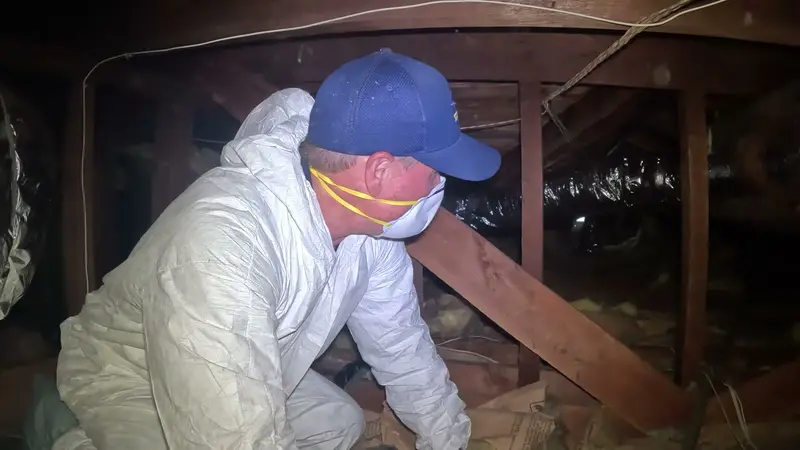
Before anyone climbs in, protective mats go down on your floors and a dust barrier goes up around the attic access, so dust and particles stay out of the rooms below. The crew works in protective suits and respirators.
Up top, droppings and nesting material come out, and insulation that is contaminated comes out with them, bagged in the attic and carried out sealed. What is left gets micro-cleaned with a HEPA vacuum, which holds the fine particles a household vacuum would blow back into the air. That is the difference between this and the homeowner advice above: the space is sealed off, the crew is in respirators, and the vacuum is built for it.
Sanitizing every surface, not a few spots
Then the whole attic is sanitized and deodorized with TwinZyme, our professional-strength enzyme treatment designed to break down rodent-related organic waste and odors.
It goes on with a battery-operated sprayer, which is one of the twins’ own tips for attic sanitizing. A lot of companies spritz around with a spray bottle, which treats the spots someone can reach. A powered sprayer covers the joists, the sheathing and the tops of the ducts evenly, which is where the smell actually lives.
Where the odor has got into the wood and whatever insulation stays, electrostatic fogging finishes the job, reaching the gaps nobody can get a hand into. Where insulation came out, new insulation goes back in only after all of that, onto a clean floor.
What gets priced
The cleanup is scoped in the Entry Point Diagnostic along with everything else: how far the droppings and nesting go, how much of the insulation is affected and whether the ducting is involved. You get the scope and the price before anything starts, so the job is priced once rather than growing halfway through.
None of this is part of a routine pest control visit. A general pest control service in Los Angeles treats pests on a schedule, inside and out; it does not take droppings, nests and soiled insulation out of your attic.
Jim and Dave, on their own channel, 626,000 subscribers.
Straight answers
- Free phone estimate before any work
- Cleaned only once trapping shows the rats are gone
- HEPA-vacuumed, then sanitized with TwinZyme
- Dust barrier at the hatch, mats on your floors
- Family owned since 1982
Related
The rest of the work
Rat Control
About half the rat jobs here are roof rats, which climb in above your head through the roofline, the attic vents and the trees touching your eaves. Most of the rest come up through the plumbing, which is why we look at both before quoting anything.
Read more →Mice Control
A mouse fits through a gap the width of a pencil. That is why mice problems come back, the traps worked and the openings never got closed.
Read more →Free Rodent Phone Estimate
Finding exactly how they are getting in: the attic, the crawl space, the roofline, the subfloor and the plumbing. You get the entry points and a written plan.
Read more →Rodent Proofing
Sealing every opening a rodent can use, in steel and mortar. This is the part that ends the problem instead of managing it.
Read more →Vehicle Rodent Removal
Rats and mice nest in engine compartments, chew wiring and leave droppings and odor behind. A four-step process to clean it up, treat the vulnerable parts and discourage the next one.
Read more →Home Sanitation
Kitchens, cabinets, garages and crawl spaces where rats or mice have been: droppings and urine cleaned up the safe way, surfaces disinfected, odor treated.
Read more →Insulation Removal
Insulation is where rats and mice nest, tunnel and leave most of their urine. When it is soaked, it cannot be cleaned in place. It has to come out.
Read more →Insulation Installation
New insulation is the last step of an attic restoration, not the first. It goes in once the attic is sealed, clear of rodents and sanitized.
Read more →Duct Services
Attic ducting is soft, warm and runs the length of the house. Rats chew it, nest on it and leave droppings inside it, and the system then blows that air into your rooms.
Read more →We handle attic cleaning across Los Angeles County, see every area we serve, or start from rodent control in Los Angeles.
FAQ
Attic Cleaning: common questions
Can I clean the attic myself?
A small, recent problem, possibly. The CDC sets out how: gloves, ventilate first, soak droppings and urine with disinfectant or a bleach solution and let it sit, then pick it up with paper towels, never sweep or vacuum it dry. A large or long-running infestation, with nesting through the insulation, is a different job, and that is the one we do.
Do you clean the attic before or after the rats are gone?
After. The entry points are sealed first, then we trap and monitor what is left until the activity stops, and only then is the attic cleaned. Cleaning first just gives the next rats a clean attic.
Does all the insulation have to come out?
Not always. Droppings on top of the insulation in one corner are not the same as insulation soaked and tunnelled through from end to end. How much comes out is decided in the Diagnostic and written into the price.
Will the smell go away?
Taking out the droppings, nesting material and soaked insulation removes most of the source. What remains is treated with TwinZyme, which is designed to break down rodent-related organic waste and odors rather than cover them, and fogged where the smell has got into the wood.
Why does my attic still smell after another company cleaned it?
Usually because something was left behind. On one job in the twins’ films they were the fifth company called; the one before had laid brand-new insulation straight over the old droppings without vacuuming, and the attic still smelled of rodent. The fix was pulling the insulation back out along the runways, vacuuming, sanitizing and fogging.
Hearing Scratching in Your Attic, Walls or Ceiling?
Get a free phone estimate and straight answers about what could be happening inside your home. Family owned since 1982.